
Partner content. AGIBOT supported this coverage. TechniaHQRobot independently wrote and verified the article against AGIBOT's official release and linked project resources.
The useful part of this release is the failure data. Theme 3 preserves successful rollouts, failed rollouts, disturbances and human corrections instead of reducing robot learning to clean expert demonstrations.
Introduction
Robot learning datasets often show what a successful task should look like. Real robots spend plenty of time outside that clean path. They miss grasps, drift from the intended sequence, encounter disturbances and sometimes need a human to take over.
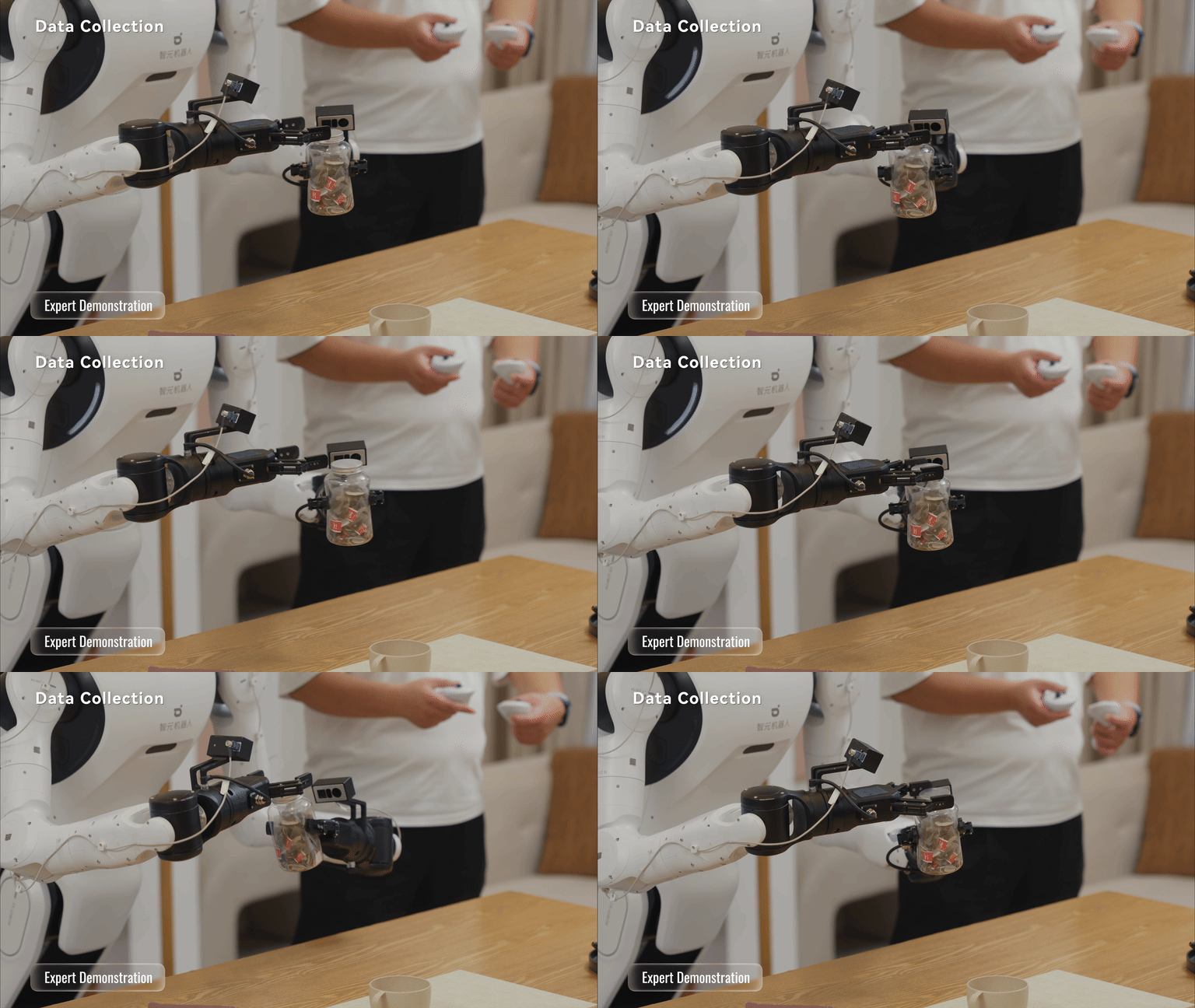
AGIBOT WORLD 2026 Theme 3 is built around those execution states. AGIBOT's first open-source batch contains 11,430 real-world trajectories across 14 industrial and household tasks, combining expert demonstrations, autonomous policy rollouts and human-in-the-loop corrections.
Information verified from official sources available as of September 4, 2026.
Direct answer
AGIBOT WORLD 2026 Theme 3 is an open-source real-world reinforcement-learning dataset with 11,430 robot trajectories across 14 tasks. The release includes 1,024 successful policy rollouts, 1,369 failed rollouts, 98,159 annotated subtask intervals, 26,493 disturbance segments, 5,795 error-state segments and 10,684 human-intervention segments.
Original X post
Open on XLoading the full X post…
Key facts
- 11,430 real-world trajectories across 14 industrial and household tasks.
- 1,024 successful policy rollouts and 1,369 failed policy rollouts.
- 98,159 annotated subtask intervals with completion-status labels.
- 26,493 disturbance segments and 5,795 error-state segments.
- 10,684 human-intervention segments that preserve where takeover begins and how correction proceeds.
- The dataset is open source through the AGIBOT WORLD project and Hugging Face.
Why failed robot trajectories are valuable training data
A successful trajectory shows a policy one route through a task. A failed trajectory reveals where that policy stops being reliable. That distinction matters for physical systems because a robot can reach the same failure state through bad perception, poor contact, an incorrect motion sequence or an unexpected change in the environment.
Theme 3 keeps those unsuccessful executions in the dataset. Researchers can inspect where a rollout diverged, how far the task progressed and what happened before a human intervention. That makes the data useful for failure recognition, recovery policies, reward modeling and value estimation rather than imitation alone.
The dataset combines demonstration, rollout and correction
AGIBOT divides the release into three complementary trajectory types. Expert demonstrations capture reference executions from human operators. Policy rollouts record autonomous model execution and preserve both successes and failures. Human-in-the-loop trajectories retain the robot's behavior before takeover, the intervention point and the corrective actions that follow.
That structure creates a continuous record from how a task should be performed to how a learned policy actually behaves on hardware. It also preserves the recovery path after something goes wrong, which is often missing from datasets built only from successful demonstrations.
14 tasks cover precision, contact and longer execution chains
The first batch spans 14 industrial and household tasks. AGIBOT names examples including Ethernet-cable insertion and unlocking a door with a key. These are useful reinforcement-learning cases because they require more than reaching a visual target. The robot has to manage contact, sequence actions and respond to execution feedback.
The release is therefore relevant to manipulation research where small errors accumulate. A cable can be aligned but not fully inserted. A key can reach the lock but fail to rotate correctly. Those partial states are important because they sit between a clean success label and a total failure label.
Fine-grained annotations turn execution into learning signals
AGIBOT reports 98,159 annotated subtask intervals, 26,493 disturbance segments, 5,795 error-state segments and 10,684 human-intervention segments in the first batch. The annotations cover task progress, completion, errors, disturbances and interventions.
For researchers, that opens several directions. A model can be trained to estimate task progress, detect success, recognize errors, warn about risk or decide when human assistance is needed. The intervention segments can also support learning from corrective behavior rather than restarting every failed attempt from scratch.
What this release changes for embodied AI research
Real-robot reinforcement learning is expensive because every experiment consumes hardware time and exposes the robot to wear, collisions and recovery work. Shared trajectories cannot replace new physical experiments, but they can reduce duplicated collection and give research teams common data for comparing methods.
The broader shift is from learning only what successful behavior looks like toward modeling what happens during execution. For humanoids and other general-purpose robots, reliable work will depend on recognizing when an action is going wrong and recovering before a small error ends the full task. Theme 3 gives researchers data specifically around that boundary.
Limitations and missing information
- This is a dataset release, not evidence that a general-purpose robot can autonomously complete arbitrary industrial or household work.
- The published counts describe the released trajectories and annotation segments; they do not by themselves establish policy generalization, deployment reliability or production-level task success.
- Researchers still need to evaluate how policies trained or fine-tuned with the dataset transfer to different robots, objects, layouts and operating conditions.
Conclusion
AGIBOT WORLD 2026 Theme 3 puts failures, disturbances and corrections beside successful robot behavior. That makes the release useful for a part of embodied AI that is easy to overlook: teaching physical systems to identify the edge of their own competence and recover when execution departs from the intended plan.
AGIBOT says it plans to continue expanding AGIBOT WORLD 2026 with additional datasets, benchmarks and research resources.
Frequently asked questions
What is AGIBOT WORLD 2026 Theme 3?
It is an open-source AGIBOT dataset focused on real-world robot reinforcement learning. It combines expert demonstrations, autonomous policy rollouts and human-in-the-loop corrections with detailed execution annotations.
How many trajectories are included?
The first open-source batch contains 11,430 real-world trajectories across 14 industrial and household tasks.
Does the dataset include robot failures?
Yes. AGIBOT reports 1,369 failed policy rollouts, plus 5,795 error-state segments, 26,493 disturbance segments and 10,684 human-intervention segments.
Where is the AGIBOT WORLD dataset available?
AGIBOT provides the project through agibot-world.com and publishes the open-source dataset on Hugging Face under the agibot-world organization.
Sources and methodology
Share this article
Share the current TechniaHQRobot article page.
Continue reading
Open the latest robotics reporting, Physical AI analysis and hardware notes.