
Purchase offer · Global
$13,500 for base G1
Offer checked
- Taxes included
- No
- Shipping included
- No
China · Reviewed 2026-10-11
Compact humanoid with depth camera, 3D LiDAR and multiple developer configurations.
Published offer
$13,500 for base G1
Availability: Available
01 / At a glance
Whole-body control, manipulation, teleoperation and research
02 / Hardware profile
03 / Pricing and purchasing
Purchase offer · Global
Offer checked
04 / Technical analysis
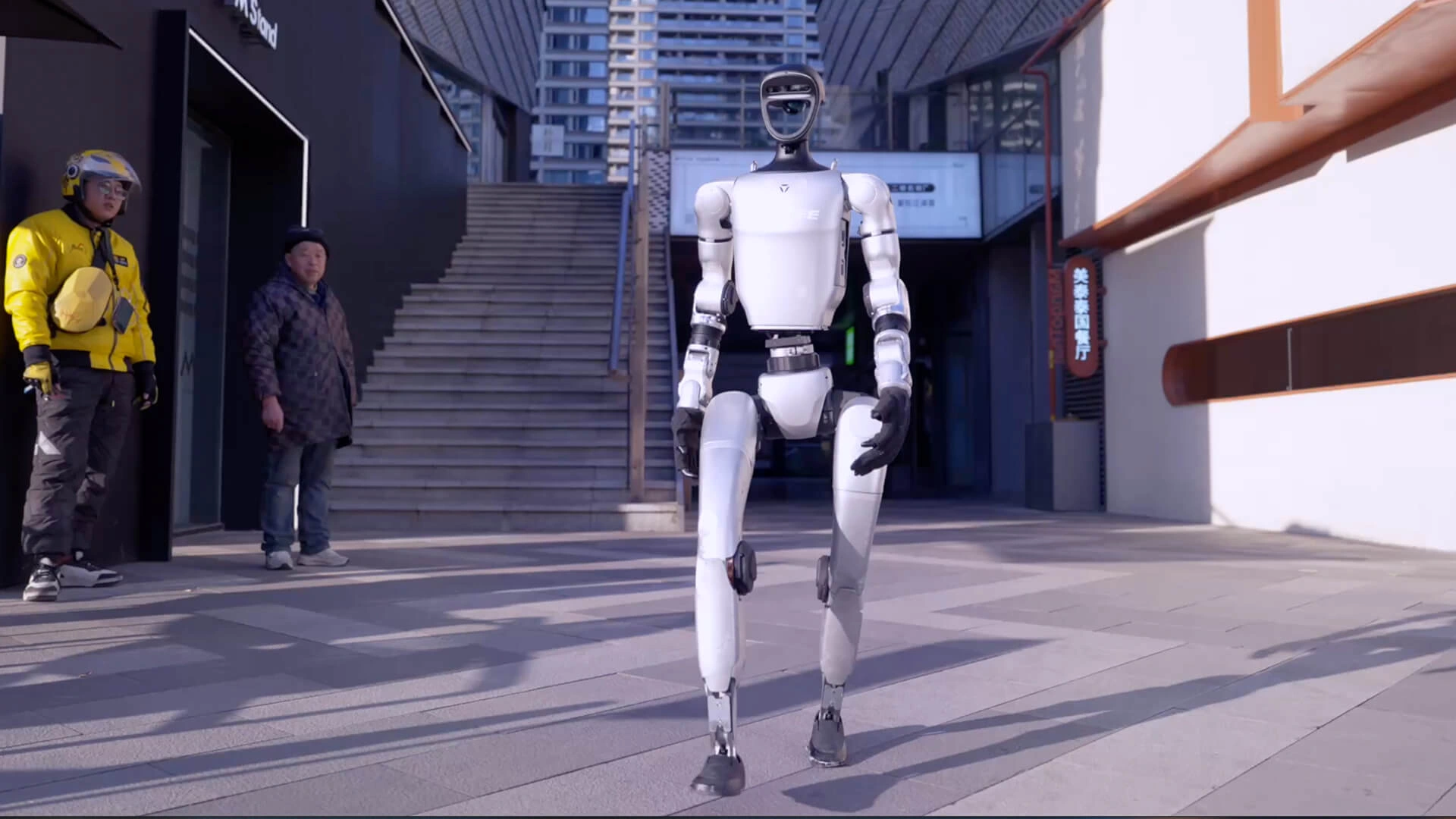
G1's published configurations pair biped legs with arms, a depth camera and 3D LiDAR; higher-spec development editions can have different articulation and hand options. Moving a carried object changes the robot's center of mass and the ground reaction forces needed for balance. A stable walking clip without manipulation cannot establish success in a pick-and-place workflow. Development teams should verify motor limits, sensor calibration and the exact joint mapping of the purchased model before retargeting a simulated policy.
Unitree's standard G1 specification describes 23 body degrees of freedom: six in each leg, five in each arm and one at the waist. G1 EDU variants can reach 43 depending on optional joints and a three-finger hand. The optional Dex3-1 hand has seven actively controlled finger degrees of freedom, distributed across the thumb, index and middle fingers. A model described as 43-DoF should therefore identify its exact installed wrist and hand package.
Unitree lists approximately 35 kg mass with battery, a standing height of 132 cm and a 0.6 m combined thigh-and-calf length. The vendor specifies a maximum knee joint torque of 90 N·m on standard G1 and 120 N·m for a stated EDU configuration. Those figures cannot be converted into a universal payload without accounting for arm position and walking state.
The G1 product sheet lists a depth camera, 3D LiDAR, dual joint encoders, Wi-Fi 6, Bluetooth 5.2 and a quick-release 9,000 mAh battery. Its advertised battery life is about two hours under the manufacturer's conditions. Development access differs between ordinary and EDU editions, so an SDK example written for EDU is not evidence that the standard sales version supports joint-level programming.
To test real manipulation, measure the same object pickup with the body standing still and while walking slowly. Publish object mass, camera pose, arm joint targets, task successes, failed grasps and any manual recovery. This distinguishes walking capability from repeatable bimanual work.
01
The base G1 has 23 joints and costs $13,500 before tax and shipping. G1 EDU adds configuration choices, including three-finger hands, wrist joints, waist joints and extra compute. The table lists 23–43 joints for EDU.
02
Both editions list a depth camera and 3D LiDAR. Secondary development is listed for EDU only. A camera or a dexterous-hand option does not establish autonomous task success; ask for the control interfaces and software included in the selected configuration.
The recorded $13,500 price, 35 kg mass and 23 joints refer to base G1. G1 EDU has 23–43 joints depending on options. Optional hands, wrist joints and extra compute are not included in the base specification.
05 / Comparable models
| Field | Unitree G1 | AgiBot X1 | X-Humanoid Tiangong Omni |
|---|---|---|---|
| Height | 132 cm | 130 cm | 135 cm |
| Mass | About 35 kg with battery for base G1 | 33 kg | 39.5 kg |
| Recorded degrees of freedom | 23 for base G1; 23–43 for G1 EDU | 34 | 31 |
| Source date in record | 2026-10-11 | 2026-09-20 | 2026-09-20 |
| Product source | Unitree G1 documentation | AgiBot X1 documentation | X-Humanoid Tiangong Omni documentation |
Unitree G1 is recorded as 2 cm taller than AgiBot X1.
Unitree G1 is recorded as 3 cm shorter than X-Humanoid Tiangong Omni.
Community ratings
Hands-on community feedback is moderated before publication. Technical sub-ratings are optional.
—
No published reviews yet
Be the first to submit hands-on feedback for moderation.
06 / References
Continue browsing